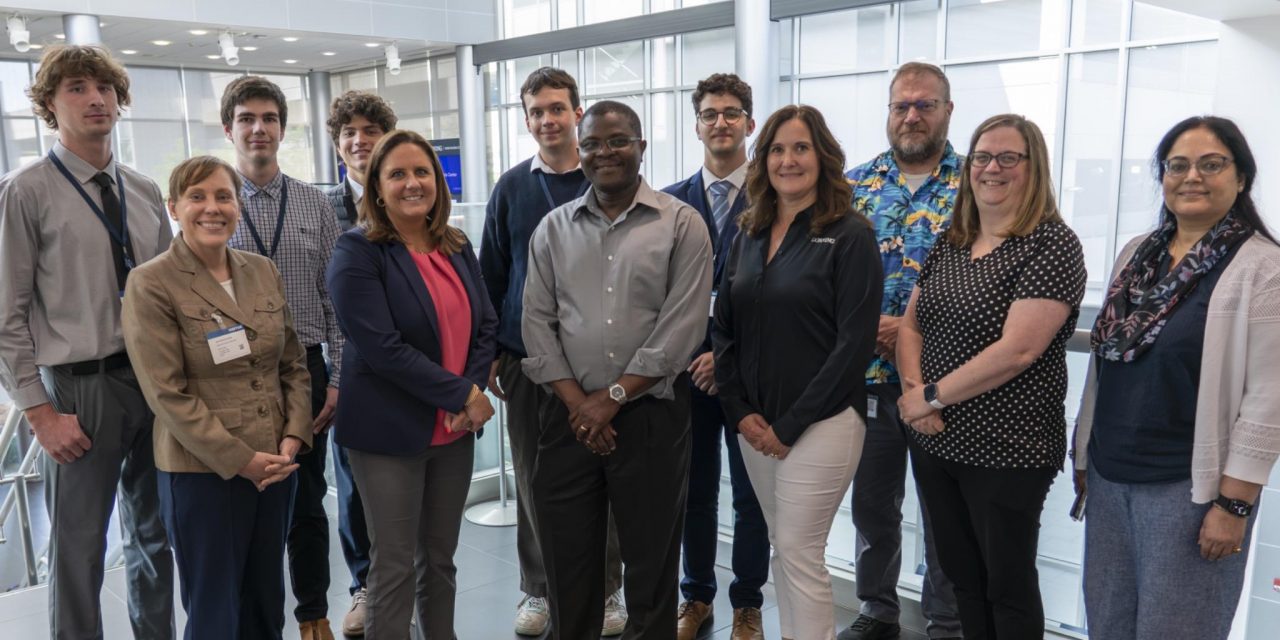
Following 10 weeks of research through Clarkson University’s Honors Summer Research Program, five students took their work off campus to share it with industry leaders at Corning Incorporated, a global materials science company.
In July, Honors students Kevin Bou Abdallah, Emilio Jakubek, Mihail Kazankovski, Garett Waltman and Jack Smith traveled to the company’s research and development center in Corning, New York, where they presented their work, toured manufacturing operations and connected with engineers, executives and Clarkson alumni.
The students were selected by the university to participate in the Honors Program’s longstanding collaboration with Corning. As part of this collaboration, Corning provides support to the program for summer research activities and offers participating students opportunities for professional development, industry exposure, and engagement with company professionals.
“It was exciting to visit Corning and share my research with professionals from so many different fields,” says Kazankovski. “Getting to present my work to people with different backgrounds made the experience especially valuable.”
Summer of Discovery
The students participated in the summer research program from May 25 through July 30, pursuing projects spanning engineering, physics and data science.
Abdallah, a senior studying Aerospace Engineering and Data Science, investigated lightweight, 3D-printed lattice structures with potential aerospace applications, while Aerospace and Mechanical Engineering junior Jakubek explored more efficient ways to model composite materials used in modern aircraft.
Kazankovski, a junior double majoring in Electrical Engineering and Physics, worked to improve predictions of heat buildup in increasingly powerful computer chips.
Chemical Engineering students Waltman and Smith, both juniors, each investigated plasma-based approaches to treating water contaminated with PFAS, commonly known as “forever chemicals.”
Beyond their research, students participated in weekly workshops at Clarkson designed to strengthen their communication skills, including their ability to explain complex ideas to different audiences. They also attended a dedicated oral presentation workshop led by Honors Program Director Kate Krueger and Associate Director Stephen Casper, where they practiced delivering 10-minute presentations to prepare for an industry audience.
“At the start of the summer, I lacked confidence in presenting technical data,” Smith says. “Through the mentorship of the Honors Program and support from Corning, I became a confident technical speaker and learned to translate experimental findings into meaningful insights for industry professionals.”
The program began with an orientation and onboarding session hosted by Ruchi Tandon, manager of university collaborations at Corning, which helped align the students with sponsorship/mentorship program expectations and provided an overview of Corning, its business areas, and the industry context for their work.
On July 24, students put those skills to the test at Corning’s Sullivan Park Research and Development facility, presenting to an audience that included executives, engineers, human resources representatives and Clarkson alumni.
Among the Clarkson alumni supporting the students was Corning’s Director of North America Engineering Rose Coluccio ’92. Coluccio remains actively connected to her alma mater and welcomed the students during their visit to Sullivan Park, offering the opportunity to connect with an accomplished Clarkson graduate working in industry.
Coluccio’s involvement reflects the role Clarkson alumni play in strengthening the university’s relationship with Corning and supporting the next generation of engineers.
“It’s incredibly rewarding to see the Honors students share their work, engage with our teams at Corning, and gain exposure to opportunities in industry,” says Coluccio. “As a Clarkson graduate, I’m proud to be part of a program that helps prepare the next generation of engineers and leaders.”
Following their presentations, students answered questions and discussed their research with Corning professionals.
For Abdallah, preparing to present his research meant learning to focus less on methodology and more on what his findings revealed.
“I thought more carefully about what my findings meant beyond the lab,” he says. “Initially, I focused too much on the methods I used rather than what I discovered. I learned to explain my results more clearly, including where my models didn’t match the experiments and why. The questions from engineers helped me to understand the importance of making technical information accessible to different audiences.”
Students also connected with engineers and executives during a networking lunch and toured the company’s Diesel manufacturing plant, gaining firsthand insight into its operations and potential career opportunities.
“Visiting Corning gave me a better understanding of the company’s scope,” says Waltman. “I knew Corning for Pyrex, but its products range from iPhone glass to fiber optic cables. Seeing the processes behind them showed me how much innovation goes into the products we use every day.”
Future Connections
For this year’s Honors program students, the relationship will continue well beyond their summer research experience.
This fall, each student will be paired with a Corning engineer for a year-long mentorship focused on professional development and career exploration. Through regular conversations, students will gain industry perspectives, receive career guidance and build on the connections established during their summer experience.
“Working with Corning has been a wonderful experience so far,” Abdallah says. “I’ve improved my oral communication, research and leadership skills while learning from industry experts and company executives. They’ve also supported me as I look for full-time roles post-graduation.”
The mentorship extends the impact of the Honors program beyond the laboratory, giving students continued access to industry professionals as they explore how their interests and skills might translate into future opportunities.
“The experience really bridged the gap between what I’ve learned in the classroom and how that knowledge is applied in industry,” says Smith. “Seeing Corning’s facility firsthand and learning about its cutting-edge innovations made me excited for my engineering future and opened my eyes to the many impactful paths available in chemical engineering.”