A Clarkson Honors student feature | Mechanical Engineering ’26
CLARKSON HONORS / MECHANICAL ENGINEERING
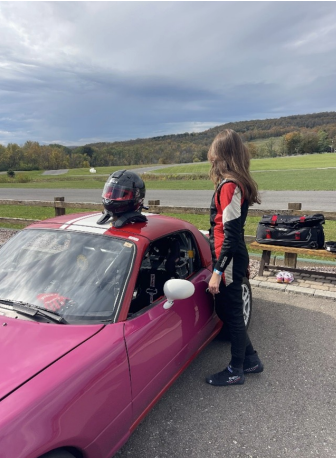
On a Saturday at Pineview Run raceway, the air smells like hot brakes and ambition. Between sessions, a 1990 pink-in-progress Mazda Miata idles under a hardtop while its driver crouches by the left front tire, not with a torque wrench but with a notebook.
Lauren Pawlika talks tires the way other Clarkson students talk about rockets. She’ll describe the way a medium compound comes in just as the track temp lifts, and then she’ll show you the traces: pressure and temperature changes lap over lap, wear patterns that look like tiny maps, and the way a driver’s inputs whisper back through the sidewall.
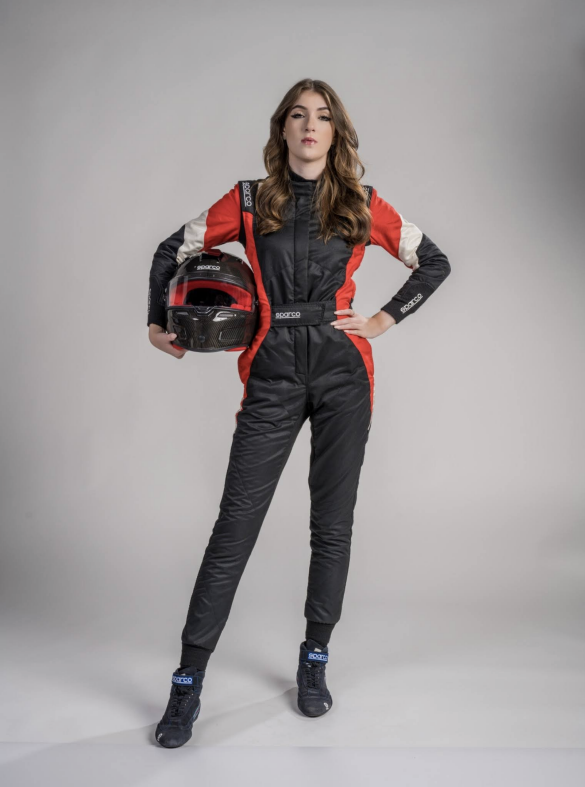
She’s a senior in Mechanical Engineering at Clarkson University, and most of her education happens where asphalt meets rubber. As a race and tire engineer with Donovan Motorsports, she has spent long days in the pits and on the wall, logging data, making changes, and watching a car’s performance pivot on decisions measured in single PSI. She drags that same data into her Honors Capstone, where it becomes models, charts, arguments, and a story that starts with a stopwatch and ends as engineering.
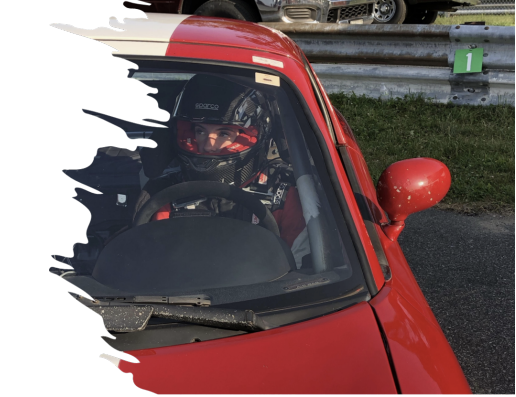
She’s precise. Her Miata—1990, hardtop, SCCA novice permit earned this summer—is both lab bench and instrument, a small, spirited chassis that makes the consequences of every choice obvious.
It forces you to be fit, focused, and present. Everything about your inputs shows up on the tire.
When Pawlika is at Pineview, she’s often surrounded by bigger numbers: Mustangs in loud colors, a member handing her keys to a Supra “just to see,” LMP3s in other paddocks that speak a different language of downforce and speed. The Miata doesn’t care. Nor does Lauren. What it lacks in horsepower it repays in honesty.
Her Honors capstone is built on that premise: tire behavior is the plot of racing. Over the summer, the SVRA schedule shuffled, a full race weekend vanished, and Lauren did what engineers do—she adapted. She kept collecting, added track-day data, and, when the opportunity arose to work with an LMP3 effort, folded in a different regime of load and temperature. Her project now spans showroom-stock Miata and prototype-level aerodynamics, a spectrum of use-cases that turns a student paper into a living experiment.
Race days are where the story starts. She’ll roll the car off the trailer, check pressures cold—knowing exactly where she wants them to land hot—and then drive for feel and evidence. In the paddock, tires become pages: scuffed edges that tell you how a corner compromised the line; feathering that scolds you for impatience; marbles that cling to a shoulder and ruin the next lap until you clear them. She writes it down. She films it. She adjusts. Then she goes back out and tests the hypothesis, the only way that counts—at speed. Most undergraduate research stays inside the building. Lauren runs hot, at speed, with consequences.
ABOUT THE PROGRAM
Clarkson Honors
Clarkson Honors is the university’s program for students who want to take the long way through their major. Honors students at Clarkson pair rigorous coursework with a multi-year capstone, faculty mentorship, scholarships, study-abroad funding, and a tight cohort of peers who run experiments that don’t always fit inside a lab.
Mechanical Engineering at Clarkson
Clarkson’s Mechanical Engineering program is hands-on by design. Students work on suspension geometry and biomedical devices, and the flow of heat and stress through new materials. They run wind tunnels, race the SPEED team’s machines, and—like Lauren—take what they learn into the world and test it where it counts. Curiosity, precision, and a willingness to be measured.